Oman holiday
Travel tips, best time to visit & highlights for your Oman holiday in Asia
Oman is the elegant alternative to Dubai: Instead of ostentation and skyscrapers, the Sultanate offers authentic Arab culture, spectacular natural landscapes, and a tranquility that is unmatched in the region. Jebel Shams (Oman's Grand Canyon), the wadis with emerald green pools, endless desert dunes, and the historic incense route make Oman one of the most fascinating travel destinations in the Middle East.
Capital
Muscat
Language
Arabic
Currency
Rial Omani (OMR)
Time zone
UTC+4
Flight time from DE
approx. 6.5 hours
Entry requirements
Passport + eVisa (apply online)
Top hotels & accommodations in Oman
Selected hotels and holiday accommodations in Oman — with images, reviews, and direct booking links with our partners.
Mövenpick Hotel & Apartments Ghala Muscat
Maskat, Oman
Millennium Resort Salalah
Salalah, Oman
Grand Millennium Muscat
Maskat, Oman
Hormuz Grand Hotel
Maskat, Oman
Al Bustan Palace - A Ritz-Carlton Hotel
Maskat, Oman
Anantara Al Jabal Al Akhdar Resort
Sayq, Oman
Hilton Salalah Resort
Salalah, Oman
Six Senses Spa At Zighy Bay
Zaghi, Oman
Top 5 highlights in Oman
The places you absolutely must not miss.
Muscat
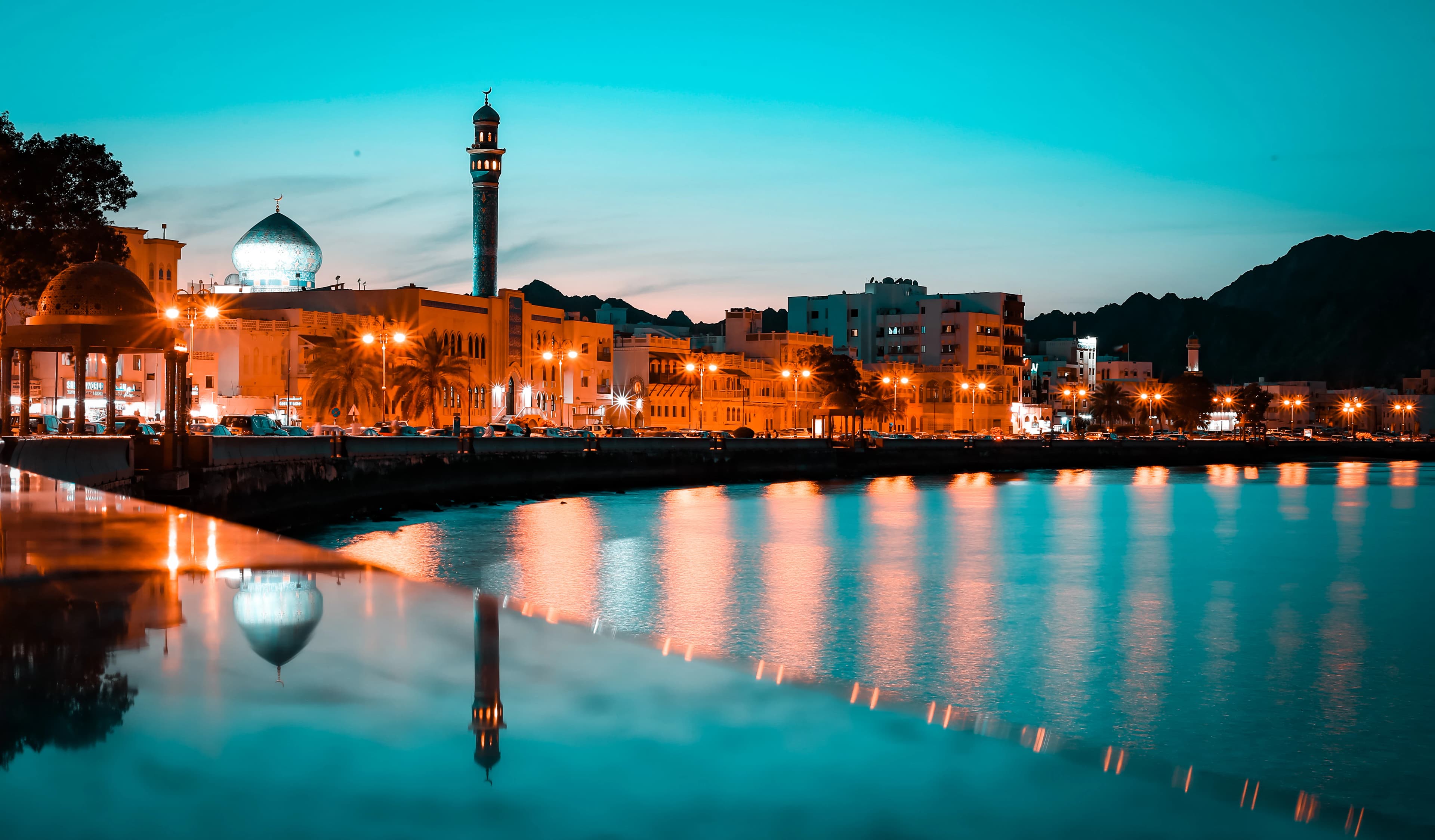
Elegant capital with the Sultan Qaboos Mosque, the Muttrah Souk, and a corniche between mountains and sea.
Jebel Shams
The 'Grand Canyon of Oman' with a 1,000m deep gorge and the spectacular Balcony Walk.
Wadi Shab
Emerald green pools between rock walls – the most beautiful wadi in Oman with a hidden cave waterfall.
Wahiba Sands
Golden sand dunes of the Sharqiya Desert: Bedouin camps, dune driving, and stargazing.
Land of Incense (Dhofar)
The south of Oman: Incense trees, the monsoon rains of Khareef, and the ancient port city of Salalah.
Hotels in Oman
Vergleiche tausende Hotels, Apartments und Resorts auf Expedia – mit Bestpreis-Garantie, kostenloser Stornierung und Bonuspunkten.
* Weiterleitung zu Expedia.de. Es gelten die dortigen Nutzungsbedingungen.
Reise-SIM für Oman
Prepaid-SIM mit Datenvolumen für Oman. Einfach einlegen und sofort lossurfen – keine Roaming-Gebühren.
* Weiterleitung zu travSIM.de. Es gelten die dortigen Nutzungsbedingungen.
Reiseversicherung abschließen
Rundum-Schutz ab 9,90 € auf TravelSecure.de
Pauschalreisen & Rundreisen
Berge & Meer – 170 Tage Cookie
Best time to visit Oman
Recommended travel time
October–March (cooler months)
Summer
35–45°C
Winter
20–28°C
How much does a holiday in Oman cost?
Average cost per person per day (excluding flight)
Budget
50–80€
Hostel, street food, public transport
Mid-range
80–160€
Hotel, restaurant, excursions
Luxury
160–350€
Boutique hotel, fine dining
5 travel tips for Oman
Insider knowledge to make your holiday better.
A 4x4 rental car is almost mandatory – many highlights are only accessible off-road
Respectful clothing: cover shoulders and knees, especially in mosques
Start wadi hikes only in the morning – afternoon flash floods can occur
Omanis are extremely hospitable – gladly accept tea invitations
Friday is a day of rest – souks and shops are often closed, enjoy nature
Food & drink in Oman
These dishes you must try!
Discover Oman
5 regions, cities and highlights in Oman
Cities

Muscat
Muscat is the capital of the Sultanate of Oman and one of the most elegant metropolises in the Arab world — a city nestled between the rugged Hajar mountains and the turquoise blue Gulf of Oman, blending Arab tradition with cosmopolitan modernity, without the ostentatious exaggeration of neighboring countries. The Sultan Qaboos Grand Mosque is an architectural masterpiece: the largest hand-knotted carpet in the world (4,200 m², 1.7 billion knots, 28 tons) covers the prayer hall, while an eight-ton Swarovski chandelier hangs from the 50-meter-high dome. The mosque is one of the few in the Arab world that is open to non-Muslims. The Royal Opera House Muscat combines Arab architecture with world-class acoustics and attracts artists from Plácido Domingo to the London Philharmonic. Right next to it lies the Mutrah Souq — one of the oldest and most atmospheric bazaars on the Arabian Peninsula, where incense, silver jewelry, textiles, and spices are traded in labyrinthine alleys. The Mutrah Corniche winds between the sea and the mountains and offers a breathtaking view of the illuminated fortresses and the harbor at sunset, where traditional dhows anchor alongside modern cruise ships. Muscat is the gateway to Oman's spectacular wadis, deserts, and mountains.
Muscat
Muscat, the capital of Oman, stretches along a dramatic coastline between rugged mountains and the Arabian Sea. In contrast to its glittering neighbor Dubai, Muscat emphasizes subtle elegance and authentic Arab culture. The Sultan Qaboos Grand Mosque impresses with the world's largest hand-woven carpet, while the Royal Opera House Muscat offers world-class performances in opulent architecture. The Mutrah Souq, with its narrow, incense-scented alleys, is one of the oldest markets on the Arabian Peninsula. The Corniche promenade connects the historic port with modern districts. Muscat is the gateway to the spectacular wadis, the Wahiba Sands desert, and the fjords of Musandam. Oman is considered one of the safest countries in the world, and Muscat is regarded as the cleanest capital in the Middle East.
Salalah
Salalah, the second largest city in Oman, is a well-kept secret of the Arabian Peninsula. While the rest of the region broils in summer heat, the coastal plain of Dhofar transforms into a lush green oasis from June to September due to the Khareef monsoon — a phenomenon that attracts visitors from across the Gulf region and one that you would never expect in this corner of the world. The transformation is spectacular: waterfalls cascade from the cliffs, wadis fill with crystal-clear water, and the otherwise barren mountains of the Dhofar range are covered with a dense green carpet. It’s as if someone transplanted a piece of Ireland into the Arabian desert. Wadi Darbat, the largest waterfall in Oman, is particularly impressive during the Khareef. But Salalah delights not only in summer. The city is the historical center of the incense route, and the trade of the precious resin has shaped the region for over 5,000 years. The UNESCO World Heritage site “Land of Frankincense” includes the archaeological sites of Al-Baleed and Shisr (the ancient Ubar), where caravans once began their journey across the Arabian Peninsula. The Al-Baleed Museum brings the fascinating history to life. The endless white sandy beaches of Salalah — Al Mughsail Beach, Fazayah Beach, and Raysut Beach — are among the most beautiful and unspoiled in the entire region. The blowholes of Al Mughsail, where the sea is shot high into the air through rock openings, are a spectacular natural spectacle. Salalah is also the center of frankincense production. The Al-Husn Souk is filled with the intoxicating scent of fresh frankincense, and visitors can sample and purchase various qualities. Frankincense trees, which grow almost exclusively in Dhofar and parts of Yemen and Somalia, thrive in the mountains above the city — a botanical wonder. The cosmopolitan history of Salalah is also reflected in its architecture and cuisine. Influences from East Africa, India, and Yemen blend into a unique culture that is distinctly different from the rest of Oman.
Regions
Oman
Oman is the elegant, cultured alternative to Dubai and Abu Dhabi – a sultanate that maintains a perfect balance between modernity and tradition. While neighboring states focus on skyscrapers and superlatives, Oman nurtures its identity: the scent of incense in the souks, majestic mud fortresses, endless deserts with Bedouin tents, and a coastline ranging from tropical bays to dramatic fjords. For German travelers seeking an authentic experience of the Orient, Oman is the perfect destination. The capital Muscat enchants with the breathtaking Sultan Qaboos Mosque, the opulent Royal Opera House, and the waterfront promenade Muttrah Corniche with its vibrant souk. Unlike Dubai, Muscat still feels like an Arab city despite its modern infrastructure – whitewashed buildings, no skyscrapers, and a deep respect for cultural heritage. The interior reveals Oman's true magic. The Wahiba Sands – a sea of golden sand dunes – invite overnight stays in desert camps, where one can fall asleep under the clearest starry sky in the world. Wadi Shab and Wadi Bani Khalid offer spectacular canyon hikes to emerald green natural pools, hidden between rock walls. Jebel Akhdar, the "Green Mountain," surprises with rose terraces, a cool climate, and villages clinging to 2,000-meter-high cliffs. In the south, the Dhofar region attracts with the Khareef – the only monsoon on the Arabian Peninsula, which transforms the landscape into lush greenery from July to September. Musandam, the exclave separated from the mainland at the Strait of Hormuz, is referred to as "Norway of Arabia" – with fjords, dolphins, and dhow boat trips. From Germany, one can fly directly to Muscat in about six hours. The best travel time is from October to April, when temperatures are pleasantly warm at 25-32°C. A rental car (ideally an SUV) is the best way to explore Oman.

Wahiba Sands
The Sharqiyah Sands (formerly Wahiba Sands) in eastern Oman are a desert straight out of a storybook: endless dunes in warm gold and red tones stretch to the horizon, shaped by the wind into elegant crests and waves that reinvent themselves with each position of the sun. What sets this desert apart from others is its accessibility: just two hours from Muscat, it offers an authentic desert experience without the extreme remoteness of the Rub al-Khali. The dunes of Sharqiyah reach heights of up to 100 meters and offer a range of experiences: from dune bashing with 4x4 vehicles over the steep sand slopes to sandboarding, which takes you down the dunes at surprising speeds. Camel rides at dusk follow the trails of the Bedouins, who still live on the fringes of the desert and welcome their guests with famous Omani hospitality. The nights in the desert are the true highlight: far from any light pollution, a starry sky of overwhelming brilliance reveals itself. The desert camps — from simple Bedouin tents to luxurious glamping resorts — offer the chance to sleep under this sky, awakened by the sunrise that bathes the dunes in a play of colors of pink, gold, and purple. The surroundings of the desert enhance the experience: Wadi Bani Khalid, just a short drive away, surprises with emerald green natural pools in a rocky oasis — the perfect contrast to the sandy desert. The traditional oasis villages on the desert's edge, where date palms, goats, and the characteristic Omani mud towers dominate the landscape, showcase authentic life in the Sultanate.
Complete guide for Oman
Regions, attractions, food, routes, costs & practical tips — all in one digital guide.
Open guidePlan a holiday in Oman
Oman is one of the most popular travel destinations in Asia, offering Desert, Nature, Culture and much more. The best time to visit Oman is October–March (cooler months), when the weather is ideal for exploration and relaxation. With a daily budget starting from 50–80€ (Budget) to 160–350€ (Luxury), Oman is suitable for various travel budgets.
From the capital Muscat, Oman can be excellently explored. The official language is Arabic, and the currency is Rial Omani (OMR). From Germany, you can reach Oman in approx. 6.5 hours. Whether you want to try culinary highlights like Shuwa, Mashuai, Harees, visit top attractions, or simply enjoy the atmosphere: Oman has something for every type of traveller.
Use our free travel tools to prepare your Oman holiday perfectly. With the holiday finder, you can discover if Oman is the right destination for you. The budget calculator helps you plan costs realistically, and with the packing list, you won't forget anything.
Suitable holiday types for Oman:
More travel destinations in Asia:
All countries in Asia